


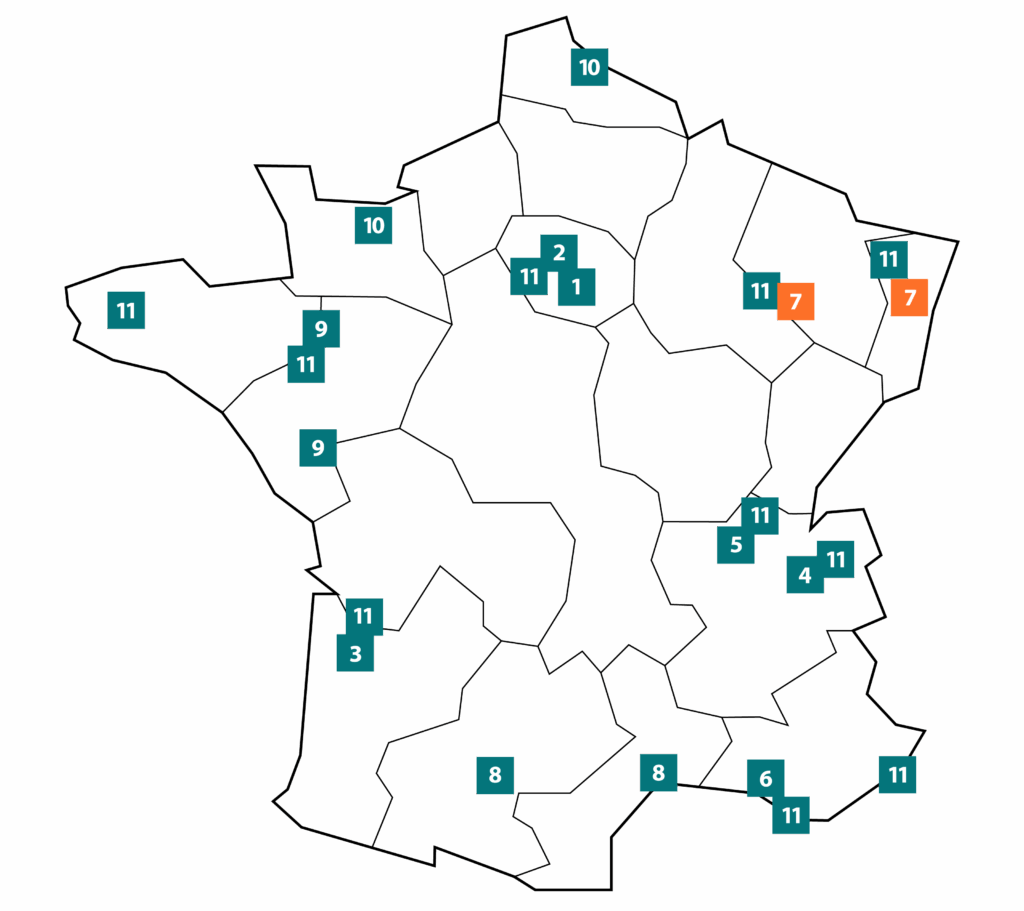
FLI’s Grand Est hub is one of the three hubs integrated into the infrastructure on June1, 2020.
It comprises five main imaging platforms with in vivo imaging modalities available and open to the research community:
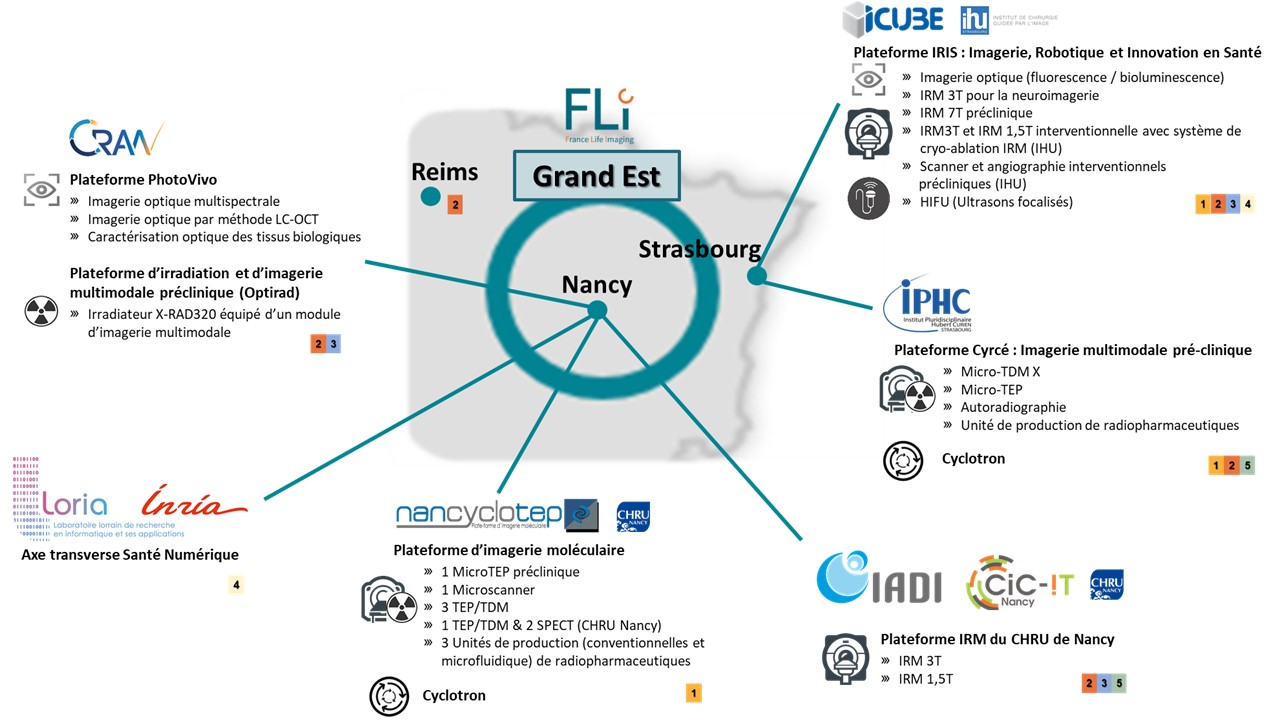
Open to academic and industrial research partnerships, the imaging facilities cover the full spectrum of in vivo imaging modalities (MRI, nuclear, ultrasound, X-ray and optical for human and animal applications). The hub boasts strong skills in instrumentation, diagnostic and interventional imaging, and robotics. These in vivo imaging platforms are complemented by strong expertise in data management, information processing and 3D navigation at the ICube laboratory in Strasbourg, LORIA-INRIA and CRAN in Nancy.
In addition, we have recognized expertise in the engineering of radiolabeling molecules for molecular imaging, combined with the production of short- and long-half-life positron-emitting radioisotopes for diagnostic and theranostic applications. This is complemented by expertise in proton beam irradiation.
Key imaging expertise and know-how developed as part of FLI’s scientific activities
The Grand Est hub has expertise in a wide range of fields:
- Functional MRI and real-time image reconstruction, movement tracking,
- Imaging the vocal tract,
- Vascular modeling and modeling of deformable organs for interventional procedures,
- 3D navigation in images to guide operations,
- Nanobiophotonics and multifunctional nanoparticles,
- Wide-field, quantitative, real-time, fluorescence and microscopic optical imaging,
- Translational research in biomedical optics (optical spectro-imaging) and multimodal panoramic imaging (oxygenation mapping),
- X-ray imaging, bioluminescence and tomography,
- HiFUs and interventional imaging,
- The development of positron-emitting molecules for molecular imaging,
- Image and data processing: 2D and 3D registration, segmentation, reconstruction, 3D navigation, feature extraction, classification,
- Brain imaging.
Preclinical and clinical imaging platforms / scientific managers :
- The IADI / CIC-IT laboratory platform in Nancy,
- The PhotoVivo platform: translational optical spectro-imaging(leaflet presenting the platform’s equipment), and the OptiRAD platform: preclinical irradiator/imager based at CRAN in Nancy,
- Nancyclotep’s molecular imaging platform in Nancy,
- The LORIA platform in Nancy,
- The IRIS platform in Strasbourg,
- The Cyrcé platform in Strasbourg.
Platform-backed research laboratories
- Laboratoire d’Imagerie Adaptative Diagnostique et Interventionnelle: IADI, INSERM U1254, Nancy,
- The Centre de Recherche en Automatique: CRAN, UMR 7039 in Nancy,
- Nancyclotep in Nancy,
- The Laboratoire Lorrain de Recherche en Informatique et ses Applications : LORIA, UMR 7503 in Nancy,
- The Engineering, Computer Science and Imaging Laboratory: ICube, UMR 7357 in Strasbourg,
- The Department of Radiobiology, Hadrontherapy and Imaging: DRHIM at the IPHC (Institut Pluridisciplinaire Hubert Curien) in Strasbourg.