


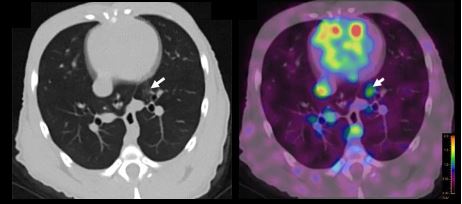
A team of researchers from the IDMIT* national research infrastructure, in collaboration with CEA’s Institut des sciences du vivant Frédéric Joliot, has developed a Positron Emission Tomography (PET) imaging strategy to visualize and quantify the whole-body distribution of SARS-Cov-2 in a primate animal model. He characterized the distribution of the virus in the acute phase of infection in the brain, kidneys, lungs and respiratory tract, and 3 months after infection, its persistence in the lungs and brain.
The imaging strategy is based on the use of a monoclonal antibody specific to SARS-CoV-2, labeled with a radioactive positron-emitting tracer. Using positron emission tomography (PET) coupled with computed tomography (CT), researchers were able to track the virus’s pathway and visualize its presence in different organs in real time.
Implemented on a primate model, this method revealed, during the acute phase of infection, the presence of SARS-Cov-2 in the lungs, brain, respiratory tract and kidneys, confirming that the virus disseminates well beyond the lungs. Three months after infection, traces of the virus were detected in the lungs and brains of convalescent animals. These results suggest that SARS-CoV-2 may persist in the body longer than previously thought, which would explain some of the persistent symptoms observed in patients with long Covid.
The body identity tracking imaging method used offers a new means of exploring the spread and long-term persistence of SARS-CoV-2 without the need for invasive sampling. This new method of examining the virus represents a promising approach to better understanding the long-term consequences. The FLI expertise network Molecular Imaging Agents, and the ANR*, provided financial support for this study.
To consult the study: Nature communications
*Infectious Diseases Models for Innovative Therapies
*National Research Agency